
Optical algorithms
Custom 2D/2.5D/3D imaging design
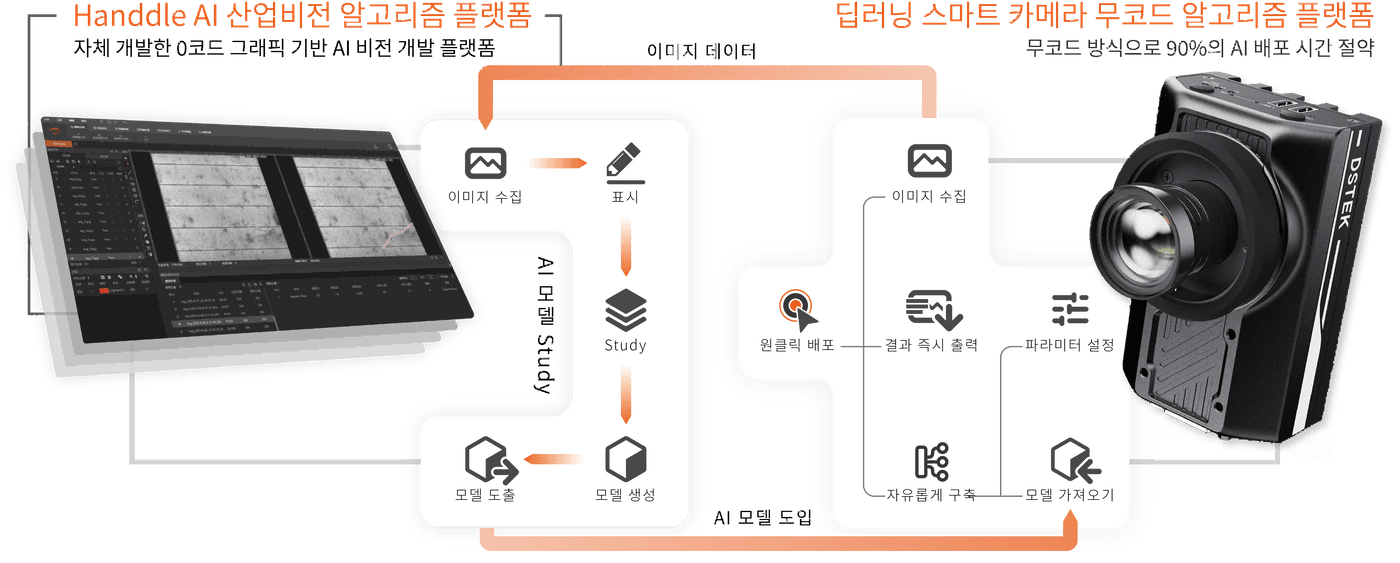
Optical algorithms, image-processing algorithms and vision deep learning are unified in one platform. Labelling, training, inference and deployment happen without code, and built-in 2D/2.5D/3D modules detect defects against complex backgrounds.
Handdle AI
Inspection begins in the optics and ends in the network. Holding all three layers in one platform means performance does not leak between them.
Custom 2D/2.5D/3D imaging design
Geometric fitting, colour processing, contour analysis
Defect detection, classification, measurement, recognition
Handdle AI
Eight modules combine into a single inspection pipeline.
Automatic object location — part presence, positional deviation and foreign matter in real time.
IOU up to 99.9%
Application-specific
Pixel-level defect segmentation yielding position, area and shape.
Automatic classification by defect type, including grading against complex textures.
Trains on good samples alone, detecting anomalies without NG data.
Length, width, angle and gap measured automatically at pixel precision.
Height, depth and flatness inspection, integrated with line laser and structured light.
Character recognition and verification: print quality, typos, label conformity.
1D/2D barcodes, QR and DPM read and linked to process traceability.
Handdle AI
Lower data dependency, without giving up accuracy or speed.
From 5
From 1 for large parts
Typically trains and deploys from 5 images — and from a single sample where the part is too large to bring to us.
0 NG
Trains on OK samples only, so a new product with no defect history can be covered immediately.
30+ models
Shared characteristics across same-material products are reused in high-mix environments.
Up to 99.99%
Application-specific
Multi-dimensional feature extraction with automatic filtering reduces over- and under-detection together.
From 1 μm
Depends on the optics · defects resolve at 2–3 pixels
Pixel-level matching of the defect region yields position and area for fine defects — resolving at 2–3 pixels where rule-based systems typically need five or more.
Up to 200 units/s
Depends on workpiece and hardware
Simultaneous software and hardware acceleration sustains full accuracy at speed. Actual throughput is sized to the workpiece, resolution, model and hardware.
5 image types
2D, 2.5D, 3D, X-ray and infrared imagery; major acceleration platforms; MES and PLC integration.
Heatmap
Exposes the basis for each decision, cutting tuning time and dissolving the black-box problem.
Handdle AI
Training and operation run as one continuous path.
Image capture → labelling → model training → model export
Import config → configure modules → predict and infer → one-click run
Data security
The default deployment is on-premise: training, inference and storage all run on customer infrastructure, and cloud connectivity is configured only on request.